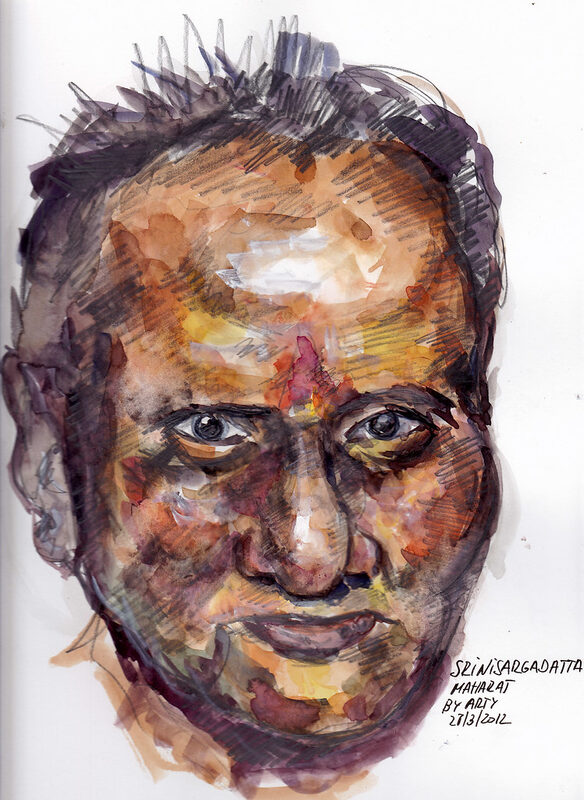
“Establish yourself firmly in the awareness of ‘I am’. This is the beginning and also the end of all endeavour.” — I Am That
Who Was Nisargadatta Maharaj?
Born Maruti Shivrampant Kambli on 17 April 1897 — Hanuman Jayanti, hence the name Maruti — he was no renunciate. He moved to Bombay after his father’s death, built up a small chain of beedi (hand-rolled cigarette) shops, married, and raised four children. In 1933, at thirty-six, a friend brought him to Siddharameshwar Maharaj of the Inchegeri lineage, who gave him one instruction: you are not what you take yourself to be — abide in the sense “I am.” He took the instruction literally and completely. Within about three years he was done.
He took the name Nisargadatta (“naturally given”) and went on living exactly where he was: teaching twice daily from a small mezzanine loft above his flat in Khetwadi, Bombay, until his death from throat cancer on 8 September 1981. The talks recorded there, translated by Maurice Frydman and published in 1973 as I Am That, became one of the most influential spiritual books of the century.
Core Teaching
The one fact nobody can doubt is I am. Hold to it. “Give up all questions except one: ‘Who am I’? After all, the only fact you are sure of is that you are. The ‘I am’ is certain. The ‘I am this’ is not.” The sense of being is the doorway — and in his late talks he pointed past the doorway itself: “You, as the Absolute, are not this ‘I Amness’, but presently you have to abide in your ‘I Amness’.” What you are is prior to consciousness.
His style was blunt, rapid, and uncompromising — a shopkeeper’s directness applied to the Absolute.
Tradition & Lineage
He belonged to the Inchegeri branch of the Navnath Sampradaya: Bhausaheb Maharaj → Siddharameshwar Maharaj → Nisargadatta. He appointed no successor. His teaching reached the world through Maurice Frydman (I Am That), Jean Dunn, who edited the final talks including Consciousness and the Absolute, and Ramesh Balsekar. He and Ramana Maharshi never met, yet their teachings converge so closely that students of one almost inevitably find the other.
Where to Start
I Am That (linked below) is the classic gateway. Within this vault, begin with Consciousness and the Absolute — his final, most distilled talks — and The Nectar of Immortality.
Further Reading
- I Am That — full text on archive.org
- Consciousness and the Absolute — full text on archive.org
- Wikipedia: Nisargadatta Maharaj
- Wikipedia: I Am That
- Wikipedia: Inchegeri Sampradaya (lineage)
Passages
- After self-realization behavior expresses itself spontaneously
- Both experience and experiencer will disappear
- I told consciousness it is you who is suffering not I
- Listening to me the same is possible you can listen and be as you are
- My state never felt the creation and dissolution of the universe
- One day when your mind has stopped functioning completely you will know
- Read the Gita sing it dance with it and allow it to transform you
- Satguru Parabrahman is all love for no- knowingness
- The Ultimate knowledge does not have any knowledge
- There is no individuality left nevertheless suffering has to be experienced
- Whatever is happening is consciousness experiencing itself
- When you are very quiet you have arrived at the basis of everything
- With what identity would you like to quit this world
- You are asking Who am I and you are not going to get an answer because the one who will get the answ
- You are just like space because space is the beginning and end of everything
- Your hunger and thirst for bliss is absolutely fulfilled
- Your true identity is beyond all concepts
- be aware of yourself and you will see light in the deepest recesses of your core
- be aware of yourself and you will see light in the deepest recesses of your core part 2 Chidakash is