“All the Buddhas and all sentient beings are nothing but the One Mind, beside which nothing exists.” — The Zen Teaching of Huang Po, trans. John Blofeld
Who Was Huang Po?
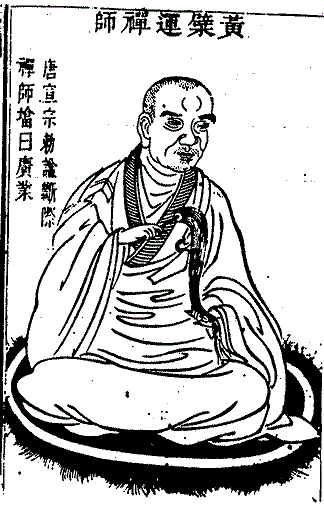
Huangbo Xiyun (d. c. 850 CE) was a Chan master of Tang-dynasty China, born in Fuzhou and ordained as a novice on Mount Huangbo in Fujian, whose name he carried for the rest of his life. The records describe him as immense — the Blue Cliff Record says seven feet tall, with a pearl-shaped lump on his forehead — and his teaching style matched: vast, abrupt, and impossible to grasp with the thinking mind.
Around 846 the scholar-official Pei Xiu built him a monastery in Jiangxi, which the master named Huangbo after the mountain of his youth. It is to Pei Xiu that we owe everything: he took notes on the master’s sermons and dialogues and compiled them as the Chuanxin Fayao (“Essentials of the Transmission of Mind”) and the Wanling Lu (“Record of Wan-ling”), with a preface dated 857. Through John Blofeld’s 1958 translation, The Zen Teaching of Huang Po, that voice still arrives undiminished.
Core Teaching
One Mind. Buddhas and ordinary beings are not two things; there is nothing to attain because nothing was ever missing. “When at last, in a single flash, you attain to full realization, you will only be realizing the Buddha-Nature which has been with you all the time.” Every practice aimed at getting enlightenment moves away from it; the seeking mind is the only obstacle. “That there is nothing which can be attained is not idle talk; it is the truth.”
Tradition & Lineage
He stands in the great Hongzhou line of Chan: Mazu Daoyi → Baizhang Huaihai → Huangbo → Linji Yixuan. His student Linji founded the school (Rinzai in Japan) that became the dominant lineage of Zen — the koan tradition descends directly through Huang Po. In this vault, Seung Sahn carries the same Zen current a millennium later, and readers of Ramana Maharshi will recognize the identical pointing: what you seek is what is seeking.
Where to Start
The Zen Teaching of Huang Po — Blofeld’s translation is short, complete, and the only book needed. The full text is freely available below.
Further Reading
- The Zen Teaching of Huang Po — full text (Terebess)
- The Zen Teaching of Huang Po — Blofeld 1958 on archive.org
- Wikipedia: Huangbo Xiyun
Passages
- All the concepts you have formed in the past must be discarded and replaced by void
- Bodhisattvas, together with all wriggling things possessed of life, share in this great Nirvanic nat
- By mercy is really meant not conceiving of a Buddha to be Enlightened
- Dharma is neither preached in words nor otherwise signified
- Do not permit the events of your daily lives to bind you
- Gateway of the Stillness beyond all Activity
- Having many sorts of knowledge cannot compare with giving up SEEKING for anything
- Having many sorts of knowledge cannot compare with giving up seeking
- If only you will avoid concepts of existence and non-existence in regard to absolutely everything yo
- If you wish to experience Enlightenment yourselves you must not indulge in such conceptions
- In truth there is no unalterable Dharma which the Tathagata could have taught
- Learn how to be entirely unreceptive to sensations arising from external forms
- Learn only how to avoid seeking for and attaching yourselves to anything
- Making use of things does not defile you error arises from your regarding each thing as having a separate self
- Mind is like the void in which there is no confusion or evil
- Only when your minds cease dwelling upon anything whatsoever will you come to an understanding of th
- Our original Buddha-Nature is, in highest truth, devoid of any atom of objectivity
- Poem - The nature of the Mind when understood
- Restrain each single thought from arising then the Eighteen Sense Realms vanish
- The Buddha is really the creation of your own Mind
- The Gateway of Non-Duality is your original Mind
- The approach to it is called the Gateway of the Stillness beyond all Activity
- The relinquishment of ALL delusions leaves no Dharma on which to lay hold
- The three kinds of relinquishment
- There are three kinds of relinquishment
- There has never been a single thing then where does dust alight
- Those who seek the Dharma must not seek from the Buddha
- To put out of mind even the principle from which action springs is the true teaching of the Buddhas
- You will recognize all minds as One and behold all things as One