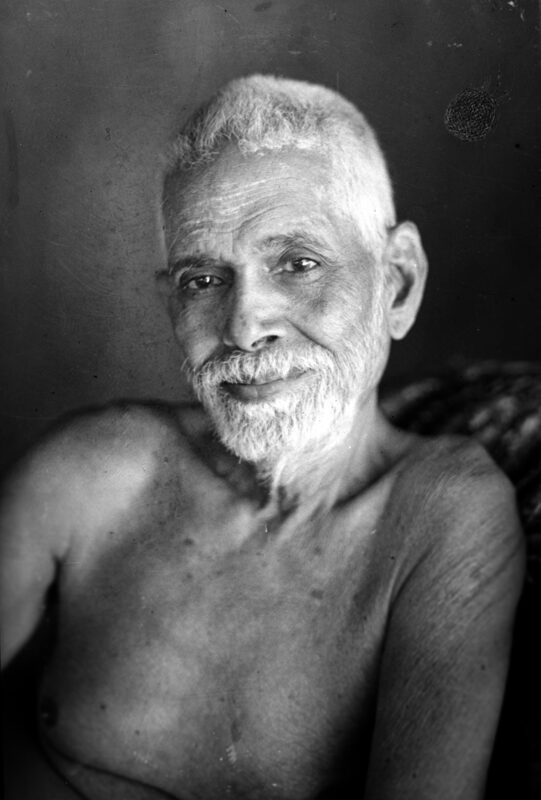
“Silence is unceasing eloquence.” — Talks with Sri Ramana Maharshi, Talk 20
Who Was Ramana Maharshi?
Born Venkataraman Iyer on 30 December 1879 in Tiruchuzhi, Tamil Nadu, he was an unremarkable schoolboy until July 1896, when — alone in an upstairs room in Madurai, aged sixteen — a sudden, overwhelming fear of death drove him to lie down and inquire directly into what actually dies. What he found was that the “I” is not the body, and the discovery never left him. Weeks later he quietly left home for the holy mountain Arunachala, arriving in Tiruvannamalai on 1 September 1896. He never left it again.
For years he sat absorbed in silence in the temple vaults and caves of the mountain, including seventeen years at Virupaksha Cave. Seekers gathered around him anyway. After his mother’s death in 1922, an ashram — Sri Ramanasramam — grew up around her samadhi at the southern foot of Arunachala, and he remained there until his death on 14 April 1950. To devotees grieving his final illness he said: “They say that I am dying, but I am not going away. Where could I go? I am here.”
Core Teaching
Self-enquiry (atma vichara): trace the “I”-thought back to its source. From his earliest written teaching, Who Am I? (Nan Yar?): “The thought ‘who am I?’ will destroy all other thoughts, and like the stick used for stirring the burning pyre, it will itself in the end get destroyed. Then, there will arise Self-realization.”
He taught complete surrender to God as an equally direct path — the two end in the same place, the dissolution of the separate “I”. But his deepest teaching was silence itself. Many who sat before him reported that their questions dissolved unasked.
Tradition & Lineage
He had no human guru and founded no formal lineage; he pointed to Arunachala itself as his teacher. His realization was spontaneous, and the tradition recognized it as fully consonant with Advaita Vedanta. His teaching radiated outward through devotees: the poet Sri Muruganar, who recorded his spoken teaching in Guru Vachaka Kovai; the English writer Arthur Osborne, his biographer and founding editor of The Mountain Path; and H.W.L. Poonja (“Papaji”), through whom his influence reached a later generation of Western teachers.
Where to Start
Talks with Ramana Maharshi — the recorded conversations of 1935–1939 — is the richest single entry point. The short text Who Am I? (linked below) is the essential teaching in a few pages. From there: Day by Day with Bhagavan, Letters from Sri Ramanasramam, and his own condensed verse teaching Upadesa Saram.
Further Reading
- Sri Ramanasramam — official site
- Who Am I? (Nan Yar?) — full text PDF
- Talks with Sri Ramana Maharshi — full text on archive.org
- David Godman — writings on Ramana and his devotees
- Wikipedia: Ramana Maharshi
Passages
- A Jnani need not prostrate before anybody nor need he give his blessings to anybody
- Abhyasa consists in withdrawal within the Self every time you are disturbed by thought
- After some time, Ashtavakra Muni happened to pass that side and, while he was about to take rest und
- All effort is only for giving up the notion that we are limited
- All that is required is to be still
- Are there degrees of illusion
- Arpana offering means that the mind gets merged in the self and becomes one with it
- Arpana offering means that the mind gets merged in the self and becomes one with it Part 2
- Arunachala Ramana is the Paramatma Himself
- Arunachala means Aruna-achala being unmoved
- As for future bondages
- Awareness is the one necessary factor states without awareness do not lead to Moksha
- BHAGAVANS HANDWRITING - There is neither speaker nor thinker in that state; so that transcendental s
- Be as you are the Self is the real book life the written pages
- Becoming a reminder of human foolishness
- Bhagavan asked who is the questioner and what is the Self
- Bhagavan discoursed on the nature of the heart
- Bhagavan rarely asked anyone for anything
- Bhagavan said his state of being was beyond subject and object
- Bhagavan spoke about the nature of jnana
- Bhagavans silence was his direct teaching he taught Self Enquiry to those who could not comprehend
- Bondages of the past the future and the present
- By whatever path you go you will have to lose yourself in the One
- Can you prove one can become Realized in the time it takes to mount a horse
- Complete erasure of the ego is necessary
- Complete surrender is prescribed do that first then see for yourself
- Conquering a thousand elephants is nothing beside this Gurus power to conquer the rutting elephants
- Crying is an act of atonement
- Do not be so sorrow stricken the master takes care
- Dont believe your thoughts
- Enquiry is not the only way
- Fortunate is the man who does not lose himself in the labyrinths of philosophy
- Give up names and forms and meditate
- God has His own plans and all these go on according to that
- He could not move as the force of Bhagavans presence held him
- He is the ocean of love and sympathy
- How did the Self that ever is Awareness bliss behave as if It had forgotten
- How shall I overcome my passions
- How to gain Divine Grace
- How to know the Real I as distinct from the false I
- I exist is the only permanent self-evident experience of everyone
- I falsely imagined till now that all these which are yours
- If Love is an attribute of the Self why is the world so miserable
- If all the false ideas and impressions are swept away and thrown out what remains is a feeling of pl
- If somebody comes back from Ramanashramam and does not talk about Bhagavan
- If something appeared to one who has not attained realization
- If the ego and all its experiences are dismissed as passing shadows the ever present ultimate realit
- If the mind is turned inwards God manifests as inner consciousness
- If you read the Upanishads you will find all wisdom there
- In olden days, when we were doing the cooking during summer, we used to have a pot into which we put
- In the Vasishtam it is mentioned how to deal with premonitions
- In the deep sleep state we lay down our ego
- Is there no way of escape from the miseries of this world
- It is enough if the mind is kept one pointed in vichara dhyana japa and parayana
- It is true wisdom for the mind to turn away From outer objects and behold Its own effulgent form
- It was pointed out that Sri Bhagavan often said the whole Vedanta
- Keep the mind steady by gently turning it inward
- Kunju Swami meets Bhagavan for the first time
- Lord, which of us is the clevererIf You have given Yourself up to me, I enjoy endless bliss, but of
- Meditation depends on the strength of mind
- Meditation is possible only if the ego is kept up
- Moral nobility and not social respectability
- Mouna means continuous speech it is the speech of self
- My propositions serve as elucidations in darkness
- Non-action is unceasing activity
- Non-duality means that only the Absolute is
- Not only was the use of vichara not confined to advanced seekers
- Om Namo Bhagavate Sri Ramanaya
- On the death of King George V devotees asked Bhagavan
- One may find hatha yoga suitable and another man nama japa
- Overcome passions by finding their source
- Peace is the inner nature of humankind
- Present bondages are said to be of four types
- Ramana Bhagavan attained jnana without any effort in an ordinary house in a narrow lane in the centr
- Realisation now consists in getting rid of this false idea that one is not realised
- Sahaja Nishta
- Self-surrender is the same as Self-knowledge
- Spiritual perfection changes even the body
- Suppose I ask you to go and wake all those people up in the dream and tell them they are not real. W
- Tattvaraya composed a bharani in honour of his Guru Swarupananda
- That is because surrender means the Self itself
- That which IS is only one it is omnipresent and universal
- That which rises as I is the mind it is only the mind
- The Muni asked is it also stated that a Guru is necessary
- The Self alone remains after all illusion is destroyed
- The Self is not born and does not die
- The Self is not somewhere far away you are always that
- The Self is realized by a certain mental activity
- The Vedas contain the truth but the truth cannot be expressed in words
- The answers to any questions that are put to you will emerge like an echo from within and they will
- The attempts of so-called social reformers are futile
- The doctrine of Advaita Non-duality taught by the ancient Rishis
- The ego-consciousness is like the root of a plant
- The greatest form of ego for an individual is to present himself as a teacher and become a guru
- The highest form of grace is silence
- The idea of one Self being aware of another Self is absurd
- The jnani sees no one as an ajnani
- The king remained motionless like a statue
- The king said that he was at the very moment placing at the feet of the Guru his body, his mind, his
- The mind is a bundle of thoughts arising from the I-thought
- The mind is only a bundle of thoughts
- The naked light in a windless place
- The one Consciousness called the mind has become the world
- The only freedom man has is to strive for and acquire jnana
- The quest of the Self alone is the direct path to right awareness
- The real worship of him is to be in mouna (silence)
- The sage does not teach by words but by his living presence
- The sense of body is a thought the thought is of the mind
- The sleep state is free from thoughts and the Self shines
- The state of Self-realisation must be beyond triputis
- The state we call realisation is simply being oneself
- The things that keep us busy are interminable
- The world is mental and it will shine as reality only in the Light of Self
- Then from some left-overs amongst our things, he took out some limes and squeezed the juice into the
- There is no bondage no liberation no aspirant no seeker
- There is no reaching the Self it is not outside you
- There is no use removing doubts one by one
- They are reading the four Vedas and you are doing Vedanta
- Three ways to describe truth - The same truth has to be expressed in different ways to suit the capa
- Titov the Russian cosmonaut returned from space and declared there is no God
- To perform one’s duty carefully is the greatest service to God
- Transforming yourself is a means of giving light to the whole world
- Transforming yourself is a means of giving light to the whole world2
- Turn the mind inward and find out who the seer is
- Until the mind rests in God it must continue to wander
- We are the truth why should we run after it like the musk deer
- We capitulate to sleep but the Self is still there
- What exists is the one Self only
- What great tapas this Ramaneswara Maharshi is doing
- What is concentration but the absolute consciousness of reality
- What is the ego and how is it related to the Self
- When Bhagavan was in Virupaksha Cave Echamma came daily
- When I enquired what it was Bhagavan led me to see
- When I once complained to Bhagavan about Chinna Swami, he instantly corrected me and I steadily stoo
- When a person reaches a certain stage and becomes fit for enlightenment
- When all these are stilled
- When the eye of knowledge is opened one realizes one remains in the Self
- Where is the mind and where are the thoughts arising from it
- Who can deny the Self of anyone
- Why is Atma vichara necessary
- Why look outward and go on explaining the phenomena which are endless
- With divine grace you can attain realisation even in an instant
- Wonder of wonders beyond understanding is your strange fear
- Yes he has come back that was my doing
- You are the constant illumination that lights up both the experiences and the void
- You who intend to celebrate the birthday
- all that one is responsible for is the purity and disinterestedness of it
- annihilation of the mind - knowledge and one-pointedness
- every species has love towards its own kind, hasn’t it_ A tiger loves a tiger, and a snake a snake
- if you COMPLETELY SURRENDER ALL your responsibilities to ME
- when dhyana becomes deep and firm it leads to sahaja sthiti